Category: Neuroscience · Mental Health · Pharmacology


8
Introduction: Why Can Cannabis Sometimes Trigger Fear?
Cannabis is often associated with relaxation, euphoria, and changes in perception. However, its effects are not always pleasant. Some people experience anxiety, panic, heightened sensitivity to their surroundings, or feelings of paranoia after using cannabis.
Scientists have been investigating why a substance that can feel calming in some circumstances can produce fear and distress in others. New research from Northwestern University, published on October 2, 2026, in Nature Communications, offers a potential explanation: a specific population of neurons in a brain region involved in fear and stress may contribute to cannabinoid-induced anxiety in mice.
The findings could help researchers understand how cannabis interacts with the brain’s threat-response systems and, eventually, explore new ways to reduce unwanted anxiety-related effects.
An important distinction: This was an animal study involving a synthetic cannabinoid, not a clinical trial demonstrating that the same mechanism causes anxiety in humans.
What Did the Scientists Discover?

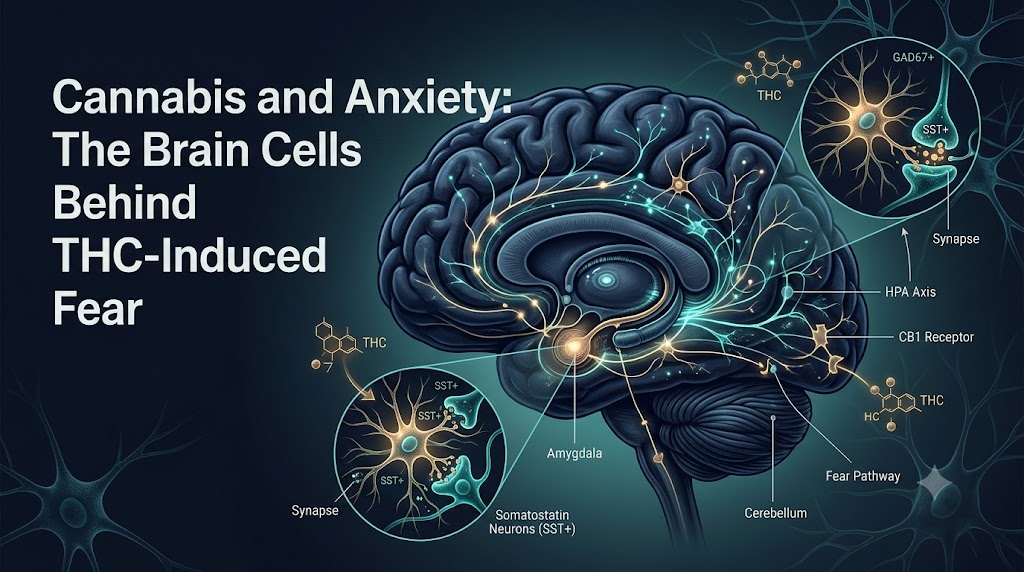
The research team focused on a small population of brain cells known as somatostatin-expressing neurons, located in the central amygdala.
The amygdala is a group of brain structures involved in processing emotionally significant information, including potential threats, fear, and stress. The central amygdala, in particular, helps coordinate defensive responses when an animal encounters danger.
The researchers found that administering a synthetic cannabinoid increased the activity of somatostatin neurons and intensified defensive responses when mice encountered an odor associated with a predator.
The team also found that experimentally suppressing the output of these neurons reduced cannabinoid-related avoidance of the threatening odor. However, this manipulation did not eliminate every defensive response, including freezing.
This distinction matters because anxiety is not a single behavior. Avoiding a perceived threat, freezing in response to danger, and experiencing a subjective feeling of panic are different phenomena. A change in one behavior does not necessarily mean every aspect of fear or anxiety has changed.
How Was the Research Conducted?
The study, led by researchers including Sachin Patel at Northwestern University, combined behavioral experiments with techniques for observing neural activity and investigating communication between brain cells.

The animal experiment
Researchers gave mice either a control treatment or the synthetic cannabinoid CP 55,940. They then exposed the animals to 2-methyl-2-thiazoline, a chemical used to simulate a predator-associated odor, and measured their defensive behavior.

Recording brain-cell activity
The team used miniature microscopy and calcium imaging to monitor activity in somatostatin neurons within the central amygdala. Calcium signals provide an indirect measure of neuronal activity.

Testing neural communication
Additional experiments on brain tissue examined how cannabinoid receptor activation altered excitatory and inhibitory signals reaching these neurons. Researchers also manipulated neuronal output to investigate whether the cells contributed causally to threat avoidance.
The results showed that the cannabinoid enhanced threat avoidance in a dose-dependent manner. The higher doses also increased freezing and affected some measures of movement. These findings suggest that both drug exposure and the surrounding circumstances can influence defensive behavior.
The Brain’s Natural Brake: Why Cannabinoids May Increase Fear
One of the most interesting findings concerns the balance between signals that activate neurons and signals that inhibit them.
Brain cells communicate through chemical messengers released at connections called synapses. Some neurotransmitters increase the likelihood that a neuron will become active, while others reduce that likelihood.
The researchers found evidence that cannabinoid receptor activation preferentially reduced local release of gamma-aminobutyric acid (GABA), an important inhibitory neurotransmitter, onto the somatostatin neurons under investigation.
In simplified terms, this may weaken an inhibitory mechanism that normally restrains the activity of these cells. When that restraint is reduced, the neurons can become more active in the presence of threatening stimuli.
How the proposed mechanism works
Synthetic cannabinoid exposure
Activates cannabinoid receptors
Reduced inhibitory GABA signalling
Less restraint on a specific neuronal population
Increased somatostatin-neuron activity
Altered activity in the central amygdala
Stronger defensive responses
More avoidance of the threatening odor in mice
Simplified interpretation of the proposed mechanism; it does not establish the same sequence in humans.
This explanation also helps clarify why cannabis-related anxiety might depend on context. If a person is already feeling stressed or unsafe, cannabinoid exposure could potentially alter how threatening their surroundings feel. However, the specific neural mechanism described here has not yet been established in people.
The findings also demonstrate why the effects of cannabinoids cannot be understood simply by labelling them as relaxing or anxiety-producing. Their effects depend on several factors, including the compound, dose, biological characteristics of the individual, and environmental circumstances.
Could This Discovery Lead to New Treatments for Anxiety?
The study raises an important question: could scientists eventually develop treatments that reduce cannabis-related anxiety by targeting the brain circuits responsible for excessive threat responses?
The answer is possibly, but more research is needed.
Understanding the brain circuit
Identifying a particular neuronal population gives researchers a more specific starting point than studying the entire amygdala. If future studies confirm that similar mechanisms operate in humans, scientists could investigate whether these pathways contribute to anxiety triggered by cannabis or other stressful experiences.
The research could also improve understanding of how the brain regulates avoidance, fear, and stress. These processes are relevant to several areas of mental health research, although the study does not establish a treatment for any anxiety disorder.
Investigating targeted therapies
Researchers may eventually investigate ways to modulate the relevant neural circuits without disrupting other brain functions. Potential approaches could include compounds acting on specific receptors or other methods of regulating neural activity.
However, manipulating somatostatin neurons directly is not currently an established treatment for cannabis-induced anxiety. These cells participate in broader neural processes, so suppressing them indiscriminately could have unintended effects.
A successful treatment would need to reduce harmful anxiety while preserving normal responses to genuine danger.
Improving prevention and clinical care
The findings could also support better research into why some people experience unpleasant psychological effects after cannabis use while others do not.
For now, avoiding cannabis or reducing exposure is more practical than attempting to manipulate a brain circuit that scientists are only beginning to understand. People experiencing recurrent panic, severe anxiety, or other distressing symptoms after cannabis use should seek advice from a qualified healthcare professional.
What Are the Limitations of the Study?
Although the research provides valuable mechanistic evidence, several limitations must be considered before drawing conclusions about human health.
Animal models are not human experiences
The experiments were conducted in mice. Avoidance and freezing are measurable defensive behaviors, but they cannot directly establish what a human feels during a panic attack.
The drug was a synthetic cannabinoid
The researchers used CP 55,940, a synthetic cannabinoid agonist. Its effects cannot be assumed to match those of every cannabis product, THC formulation, or combination of cannabinoids.
Anxiety involves multiple brain systems
The central amygdala is only one part of a much larger network involved in emotion, memory, stress, and threat detection. Other neural pathways may contribute to cannabinoid-related anxiety.
A biological mechanism is not yet a treatment
The researchers demonstrated effects on neuronal activity and threat avoidance, but they did not establish a safe intervention for treating anxiety in humans.
Individual differences remain important
Human responses to cannabis vary. Further studies must determine how factors such as dose, frequency of use, existing anxiety, and other individual characteristics influence these neural mechanisms.
These limitations do not diminish the importance of the findings. Rather, they identify the next questions researchers must answer before translating the discovery into clinical practice.
What Should Future Research Investigate?
Several research directions follow naturally from this discovery.
Human brain research: Scientists need to determine whether comparable somatostatin-neuron mechanisms contribute to anxiety following THC exposure in humans. This will require methods appropriate for studying human neural function and carefully designed clinical research.
Dose and context: Further work should establish how cannabinoid dose, baseline stress, and the presence of threatening stimuli interact. Researchers must also distinguish short-term anxiety from persistent anxiety symptoms.
Long-term effects: Studies should investigate whether repeated cannabinoid exposure produces lasting changes in these neural circuits, and whether those changes are associated with subsequent anxiety symptoms.
Safer interventions: If the mechanism is confirmed in humans, researchers could investigate interventions that reduce excessive defensive responses without interfering with normal emotional regulation or the ability to recognize danger.
These questions will determine whether the discovery leads to new preventive strategies, improved clinical care, or eventually targeted treatments.
Conclusion: A New Clue to Cannabis-Related Anxiety
The October 2, 2026, study published in Nature Communications identifies a population of somatostatin neurons in the central amygdala that contributes to cannabinoid-enhanced threat avoidance in mice.
The researchers found that a synthetic cannabinoid increased neuronal activity and strengthened defensive responses to a predator-associated odor. Their experiments also suggested that reduced inhibitory GABA signalling helps explain this effect.
The discovery offers a useful new direction for neuroscience research because it links cannabinoid exposure to specific cellular mechanisms involved in processing threats.
Nevertheless, the results should not be interpreted as proof that scientists have discovered the complete cause of cannabis-induced anxiety in humans. Nor do they establish an effective treatment.
The next challenge is to determine whether comparable mechanisms operate in the human brain and whether they can be targeted safely. If future research confirms these findings, this line of investigation could contribute to a better understanding of cannabis-related anxiety and the broader biology of fear and stress.
