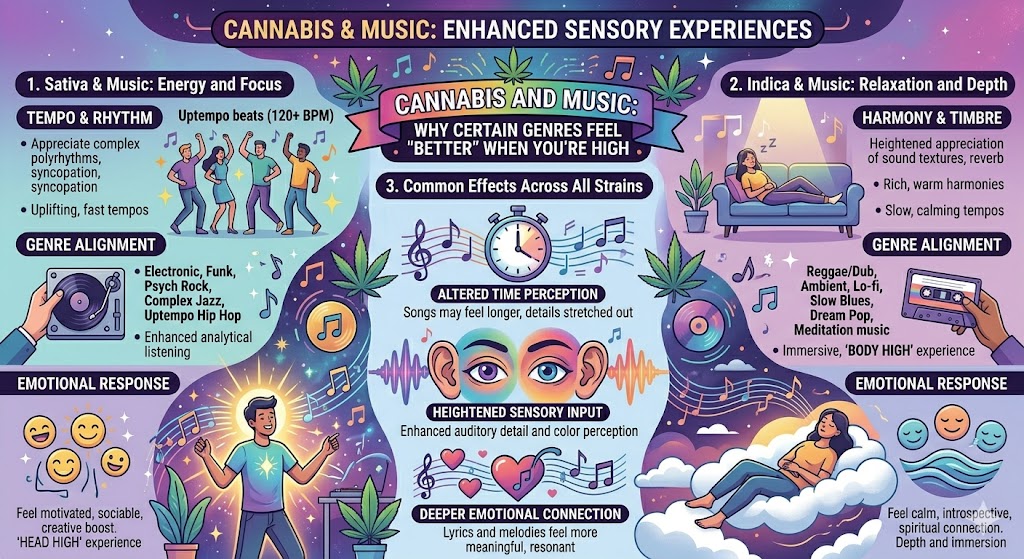
Cannabis changes time, attention, and emotion in the brain, making music feel more immersive, detailed, and emotionally intense—especially in ambient, electronic, hip-hop, and psychedelic genres.
Music and cannabis have shared a cultural bond for decades, from jazz clubs and reggae sound systems to modern electronic festivals and headphone sessions. Many listeners report that music feels deeper, more immersive, or even emotionally overwhelming when they’re high. But this isn’t just folklore—neuroscience suggests there are real (though complex) changes in perception, attention, and emotion that help explain the experience.
Below is a detailed look at why specific genres seem to “work better” under cannabis, and how your brain reshapes sound while intoxicated.
🎧 The Brain on Cannabis: Why Music Feels Different
When THC enters the brain, it interacts with the endocrinologist system, which plays a role in mood, attention, memory, and sensory processing. This affects how auditory information is filtered and emotionally interpreted.
Research suggests cannabis can alter:
- Time perception (music feels slower and more spacious)
- Attention focus (you notice details you’d normally ignore)
- Emotional sensitivity (songs feel more intense or meaningful)
- Reward processing (music becomes more absorbing, even if not objectively “enhanced”)
One of the most important effects is temporal distortion: people often experience time as stretched, which means musical moments feel longer, allowing more “space” to process each sound.
⏳ Time Stretching: The Secret Behind “Deeper” Listening
One of the most consistent effects of THC is altered time perception. A few seconds of music can feel slightly longer than they actually are, which changes how rhythm and pacing are experienced.
This leads to:
- Longer perceived pauses between beats
- Greater awareness of transitions
- Heightened anticipation before drops or choruses
In simple terms, your brain gets more “time” to process micro-details in sound.
That’s why slow builds, ambient textures, and evolving soundscapes feel especially powerful.
🎵 Why Certain Genres Hit Harder When You’re High
Not all music reacts the same way to altered perception. Some genres align naturally with how cannabis reshapes attention and emotion.
🌌 Ambient, Chillout, and Downtempo


These genres often feel “perfect” under cannabis because they rely on atmosphere rather than structure.
Why they work:
- Slow progression matches altered time perception
- Minimal lyrics reduce cognitive load
- Layers of sound become easier to separate
- Reverb and texture feel physically “spatial”
Many listeners describe feeling inside the music rather than outside it.
🎸 Psychedelic Rock & Progressive Music


Genres like psychedelic rock and prog rock are practically designed for deep listening states.
Why they work:
- Extended compositions match stretched time perception
- Layered instrumentation becomes easier to follow
- Experimental sounds feel more meaningful
- Emotional shifts feel amplified
Classic bands like Pink Floyd built entire sonic worlds that reward attention to detail—something cannabis tends to intensify.
🎧 Electronic, House, and Techno


Electronic music is highly rhythmic and repetitive, which interacts strongly with altered attention states.
Why they work:
- Repetition becomes hypnotic
- Small changes in sound feel magnified
- Bass frequencies feel physically immersive
- Rhythm can feel “visceral” rather than intellectual
A simple beat can transform into something that feels almost three-dimensional.
🥁 Hip-Hop & Lo-Fi Beats


Hip-hop and lo-fi rely heavily on groove, texture, and sampling—elements that cannabis tends to highlight.
Why they work:
- Beat details (hi-hats, samples) become more noticeable
- Bass and rhythm feel more physical
- Lyrics often feel more emotionally charged
- Lo-fi imperfections become aesthetically pleasing
Many listeners report hearing “new layers” in familiar tracks.
🧠 Dopamine, Emotion, and the “Enhanced Feeling” Effect
Music naturally activates the brain’s reward system, releasing dopamine during emotional peaks. Cannabis also influences dopamine pathways, though in a more subtle and inconsistent way.
What seems to happen instead is:
- Music becomes more emotionally salient
- Anticipation of musical changes feels stronger
- Emotional reactions are amplified (sad = sadder, euphoric = euphoric)
Interestingly, some studies suggest cannabis may increase desire to listen more than actual pleasure response—meaning you feel more drawn to music, even if brain reward activity is not dramatically increased.
This helps explain why sessions feel “addictive” or deeply engaging.
🎧 Attention: Why You Notice Things You Normally Miss
One of the most commonly reported effects is hearing hidden details in familiar songs.
This includes:
- Breath sounds between lyrics
- Subtle background instruments
- Reverb tails and echoes
- Micro-rhythms and texture shifts
Under cannabis, the brain may reduce filtering of sensory input, allowing more information to pass through attention systems. This creates the feeling of “discovering” music all over again.
🌈 Why Emotion Feels Stronger Than Sound Itself
A key insight from neuroscience research is that cannabis doesn’t simply “improve sound quality.” Instead, it changes how sound connects to emotion.
So:
- A nostalgic song feels more nostalgic
- A sad track feels heavier
- A euphoric drop feels larger than life
This emotional amplification is often what people interpret as “better music.”
🎶 The Role of Environment and Memory
Cannabis + music is not just brain chemistry—it’s context.
Factors that shape the experience:
- Lighting and atmosphere
- Headphones vs speakers
- Emotional state before listening
- Associations with past memories
Music often becomes a “memory amplifier,” where songs attach more strongly to moments and feelings.
⚖️ The Paradox: Better Experience, Not Better Music
One important clarification from research is this:
The music itself doesn’t change—your perception of it does.
Studies show cannabis can even reduce activity in certain brain regions tied to musical reward, even while users feel stronger engagement.
So the “better” feeling is a combination of:
- altered attention
- emotional intensification
- time distortion
- reduced cognitive filtering
🧩 Conclusion: Why Genres Matter More Than You Think
Cannabis doesn’t make all music equally “better”—it selectively enhances experiences that align with its effects on perception.
- Slow, atmospheric music benefits from time distortion
- Complex genres benefit from heightened detail perception
- Rhythm-heavy genres benefit from physical immersion
- Emotional genres benefit from amplified feeling
That’s why certain genres feel like they “unlock” something deeper when you’re high—they match the brain’s temporary shift in how it constructs reality from sound.
